Legal tools work better when they speak the same language. FOLIO gives them 18,000+ standard legal concepts, and these open-source tools put those concepts to work. Try each one in your browser with sample documents (no account, no API key, no upload), then build it into your own systems.
Contracts, briefs, opinions, and time entries arrive as unstructured text. FOLIO's tools turn them into structured data: every document, clause, party, and task tagged with a standard legal concept that every tool understands.
Unstructured
The officers used force against the plaintiff during the arrest, and the plaintiff sued under 42 U.S.C. § 1983.
↓→
Structured
The officers (Police Officer, Actor / Player) used force (Excessive Force Claim, Objectives) against the plaintiff (Plaintiff, Actor / Player) during the arrest (Arrest, Event), and the plaintiff (Plaintiff, Actor / Player) sued (Trial Court Filing Event, Event) under 42 U.S.C. § 1983 (Civil Rights, Objectives).
Actor / Player
Event
Objectives
Document / Artifact
Describes the whole document
Illustrative sentence and tags
Why standard tags, not just an LLM
An LLM reads legal text well, but it names the same thing differently each time. FOLIO gives each concept one permanent ID. The LLM reads it; FOLIO names it.
One concept, one ID, everywhere.
Your document system, your billing system, and the courts you file in each name things their own way. California calls a motion to dismiss a demurrer. FOLIO gives each concept one permanent ID, so a single query finds every motion to dismiss across all 50 states and every system you run.
DemurrerCalifornia
Motion to DismissNew York
Rule 12(b)(6) motionFederal
MTDBilling
Motion to Dismiss R9Xkp4FqX83NG5ZI0CDfQ1k
Document system
Billing
Analytics
E-filing
Four names (Demurrer in California, Motion to Dismiss in New York, Rule 12(b)(6) motion in federal court, and MTD in a billing system) all point to one FOLIO concept, Motion to Dismiss, which feeds your document system, billing, analytics, and e-filing.
Count what you tag.
A chart needs categories that stay put. Ask an LLM to sort 10,000 matters, and it invents labels: "MTD," "Motion to Dismiss," "12(b)(6) motion." One category splits into three bars, and every percentage comes out wrong. FOLIO tags each matter with one ID, so your percentages, trend lines, and pie charts add up.
Illustrative
Without IDs
Motion to Dismiss
912
MTD
498
12(b)(6) motion
324
01,0002,000
With FOLIO IDs
Motion to Dismiss
1,734
01,0002,000
Illustrative chart of 10,000 matters. Without IDs, one category splits into three bars: Motion to Dismiss 912, MTD 498, and 12(b)(6) motion 324. With FOLIO IDs, they merge into one bar: Motion to Dismiss, 1,734 matters.
INPUT: an unstructured court opinion.OUTPUT: structured, well-tagged data, including its document type, legal issues, parties, and citations.
Open a sample document (e.g., timekeeping narrative, contract, brief) and watch it come back tagged with its type, its contents, and the parties, dates, and citations.
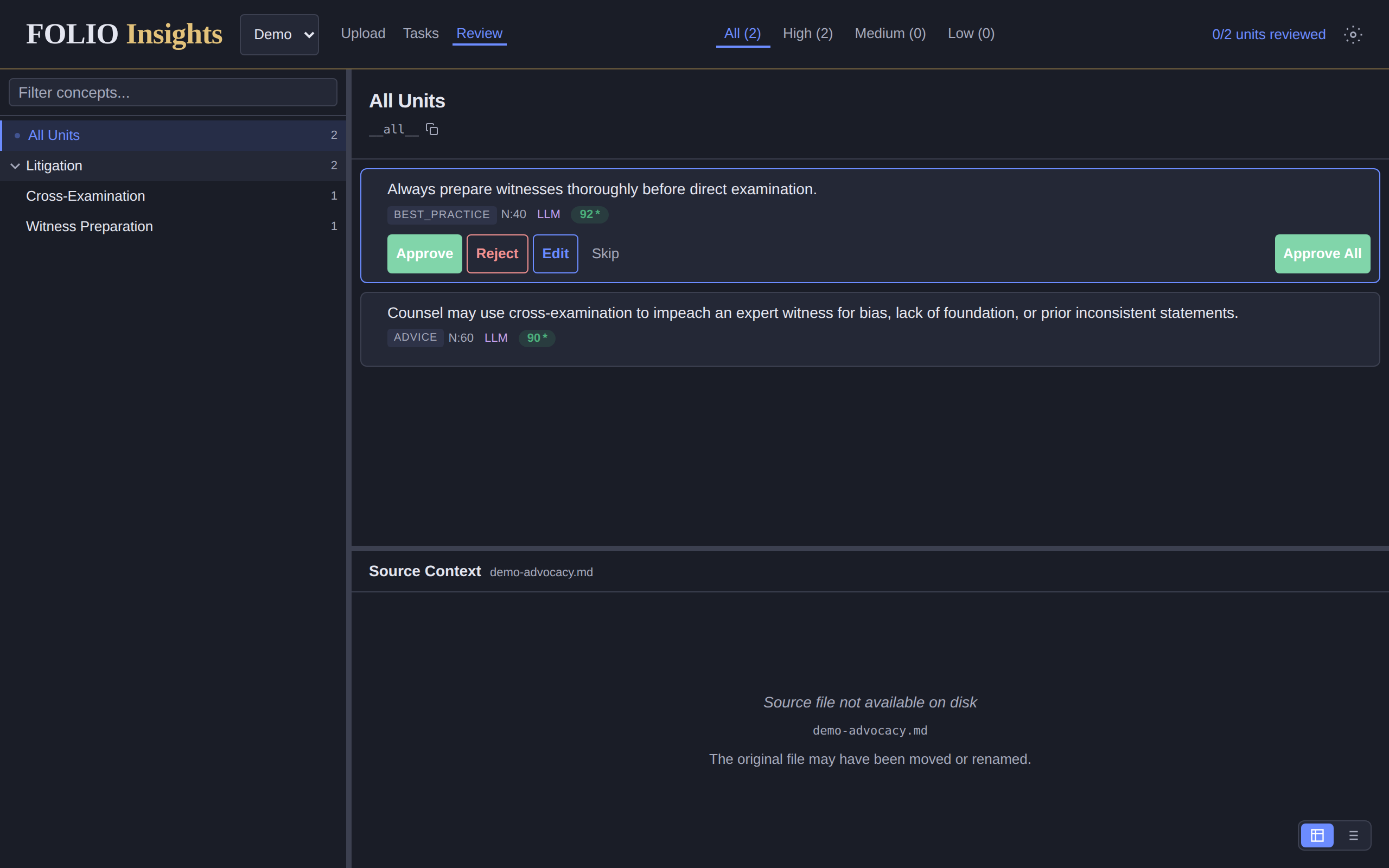
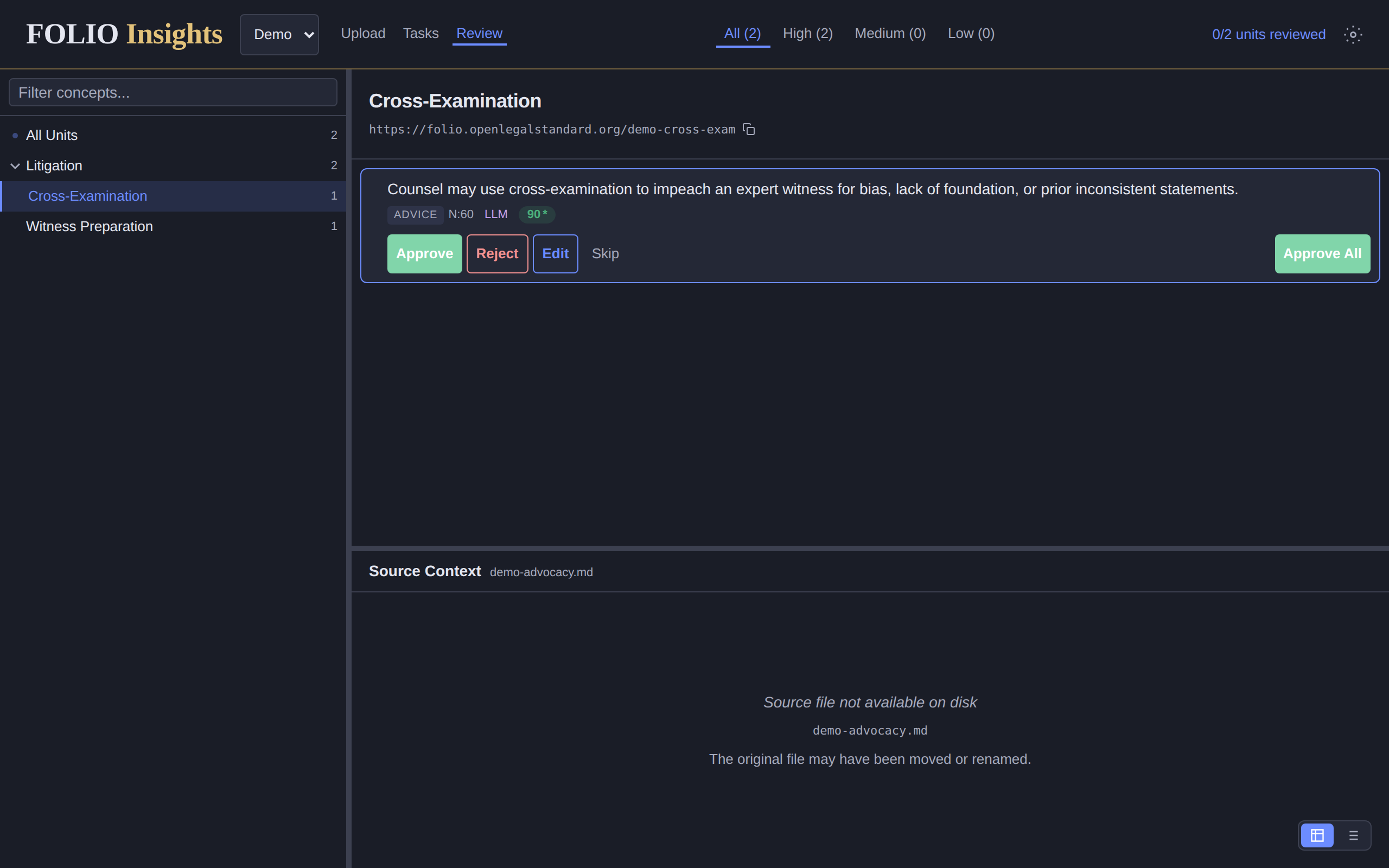
INPUT: unstructured opinions and briefs.OUTPUT: short, tagged propositions, each tied to its source words.
Turn legal documents (e.g., opinions, briefs, statutes, textbooks, contracts) into short, tagged propositions — each tied to the exact words it rests on.
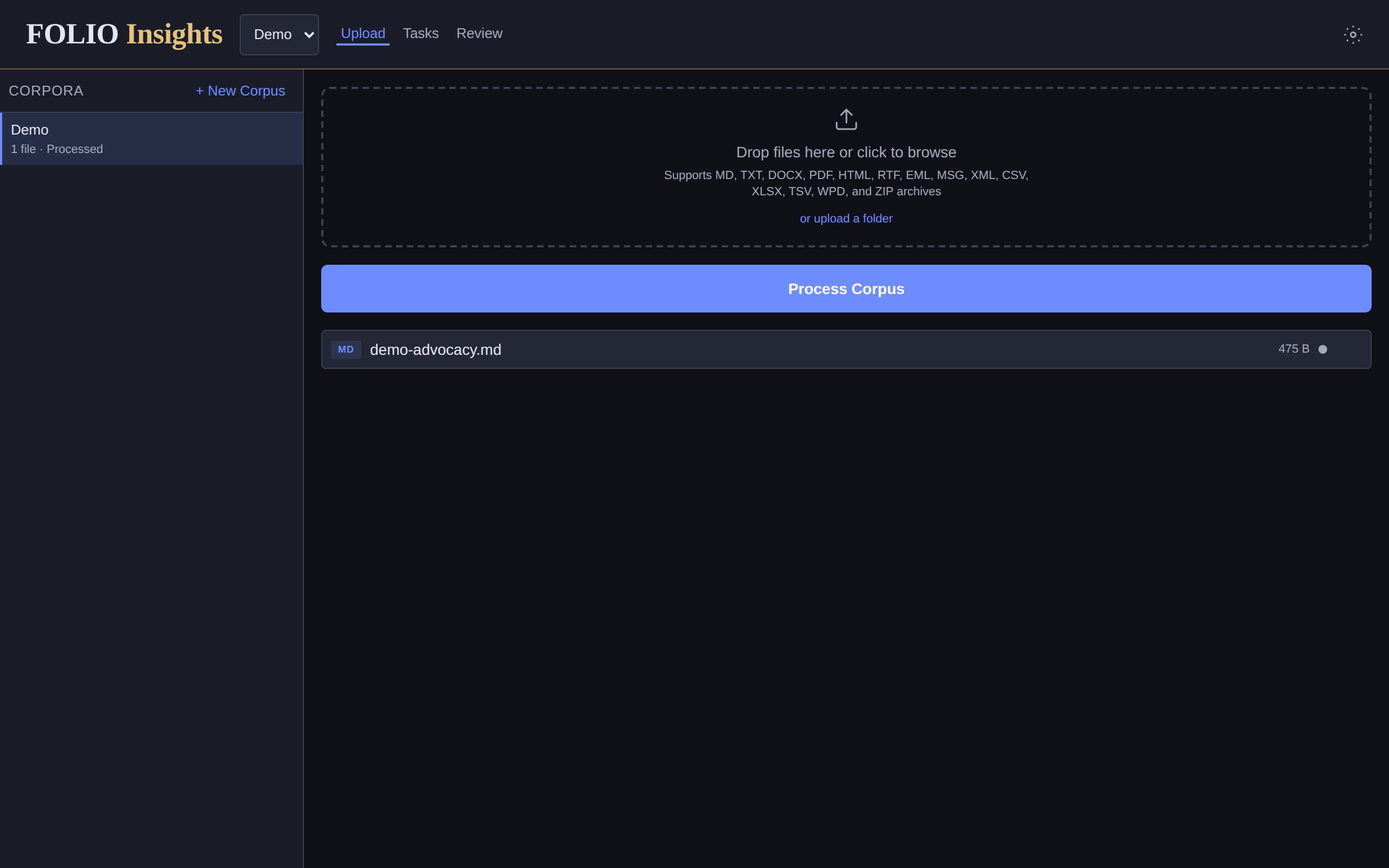
Insights runs as a preview on a small synthetic corpus.
MCP setup command: claude mcp add folio -- uvx folio-mcp. Illustrative tagged result: concept Motion to Dismiss, IRI https://folio.openlegalstandard.org/R9Xkp4FqX83NG5ZI0CDfQ1k, label Motion to Dismiss.
Who it’s for
Pick your role to see what FOLIO does for you: KM and Innovation, Law-Firm Lawyers, Corporate Law Departments, Government Lawyers, Legal Aid Organizations, Courts, and Legal Technology Companies.
Practicing law takes law and facts. FOLIO covers the law; a companion project, OpenGloss, covers the facts.
OpenGloss = Facts
OpenGloss, a companion project by Mike Bommarito. An open-source dictionary, encyclopedia, and knowledge graph of 150,000 everyday concepts, with definitions, senses, synonyms, and 9.1 million links between them. Visit opengloss.com, read the paper, and download the data from Hugging Face.
Explore all 18,000+ concepts in the browser, download FOLIO.owl, or fetch any concept as HTML, RDF, Markdown, or JSON. Try Motion to Dismiss or Murder.